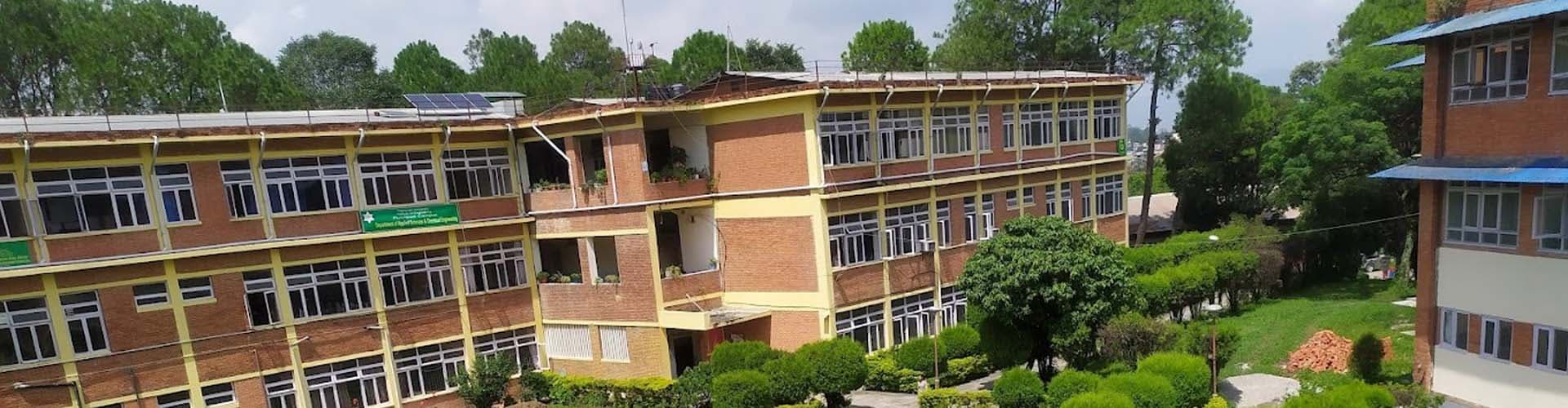
Master of Science (MSc) in Information and Communication Engineering is a 2 Year, four semester course by Tribhuvan Unviersity, Institute of Engineering.



Duration
Discipline
Level
Affiliation
Last Updated
To be eligible for admission to the MSICE program, applicants must:
Hold a Bachelor’s degree (typically a four-year program) in Computer, Electronics, or Electrical Engineering from Tribhuvan University or other recognized universities, or a degree considered equivalent to any of these fields.
Have undergraduate grades that meet or exceed the minimum standards set by the IOE Faculty Board.
Obtain the minimum required score in the entrance examination, as specified by the Faculty Board.
Applicants who meet all eligibility criteria will be selected based on merit, evaluated through the total marks secured in the entrance exam.
S.N. | Course Code | Course Title | Credit | Internal | External | Total |
|---|---|---|---|---|---|---|
1 | EG801IC | Information Theory & Coding | 4 | 40 | 60 | 100 |
2 | EG803IC | Information System Analysis & Design | 4 | 40 | 60 | 100 |
3 | EG802IC | Digital System Design | 4 | 40 | 60 | 100 |
4 | EG901IC | Telecommunication & Computer Networks | 4 | 40 | 60 | 100 |
Total | 16 |
S.N. | Course Code | Course Title | Credit | Internal | External | Total |
|---|---|---|---|---|---|---|
1 | Research & Optimization Methods | 4 | 40 | 60 | 100 | |
2 | EG851IC | Communication Theory | 4 | 40 | 60 | 100 |
3 | Elective 1 | 4 | 40 | 60 | 100 | |
4 | Elective 2 | 4 | 40 | 60 | 100 | |
Total | 16 |
S.N. | Course Code | Course Title | Credit | Internal | External | Total |
|---|---|---|---|---|---|---|
1 | Project work | 4 | 40 | 60 | 100 | |
2 | Elective 3 | 4 | 40 | 60 | 100 | |
3 | Elective 4 | 4 | 40 | 60 | 100 | |
Total | 12 |
S.N. | Course Code | Course Title | Credit | Internal | External | Total |
|---|---|---|---|---|---|---|
1 | Thesis | 16 | 40 | 60 | 100 |
Elective courses will be offered as per the availability of resource persons. Each elective course offered will of 4 credits. Here is the list of elective courses that were offered in earlier batches.
Course Code | Subject Name |
EG904IC | Neural Network |
EG855IC | Satellite Communication |
EG905IC | Digital Image Processing |
EG906IC | Radar and Remote Sensing |
EG907IC | Advanced Computer Architecture |
EG866IC | Multimedia Communication and Application |
EG918IC | Cellular Network and Planning |
EG913IC | Tele-Medicine |
EG902IC | Internet Technology |
EG903IC | Knowledge-Based System Design |
EG908IC | Computer Simulation |
EG909IC | Aviation Communication |
Bio Informatics | |
E-Government System | |
Machine Learning and Pattern Recognition | |
Color Image Technology | |
Nanotechnology | |
Big Data Applications and Analytics | |
Advance Data Mining | |
Next Generation Internet and Network Technologies | |
Speech & Language Processing | |
Natural Language Processing | |
RF & Microwave Circuit System and Design | |
Semantic Web Technology & Applications | |
EG910IC | Operating System |
EG911IC | Client-Server Distributed System |
EG912IC | Wireless/ Mobile Communication |
EG914IC | Modern Power Supply for Communication Equipment |
EG852IC | Management of Information technology |
EG861IC | Data Structure and Algorithm |
EG862IC | Theory of Automata and Formal Language |
EG863IC | Software Engineering |
EG853IC | Optical Communication |
EG854IC | Automatic Control System |
EG856IC | Computer Graphics |
EG857IC | Object-Oriented Paradigm |
EG858IC | Digital Signal Processing |
EG859IC | DataBase and File Structure |
EG865IC | CAD of Digital System |
EG919IC | Adaptive Signal Processing |
Design and analyze communication systems
Apply advanced signal processing techniques
Work with wireless, optical, and network technologies
Develop secure and efficient data systems
Use modern tools for system modeling and simulation
Solve ICT-related engineering problems
Conduct research in emerging communication technologies
Graduates of the MSICE program will take on leadership roles in the planning, design, implementation, and management of Information and Communication Technologies (ICT), playing a key role in driving IT-based development.
The Information and Communication Engineering (ICE) program is designed with the following goals:
Empower students to design, evaluate, and recommend effective ICT solutions.
Offer opportunities for students to advance their careers by gaining specialized knowledge.
Strengthen students' foundational understanding and help them develop expertise in specific ICE domains.
Prepare graduates with leadership skills to grow and innovate within the ICE industry, helping to generate new employment opportunities across various professional levels.