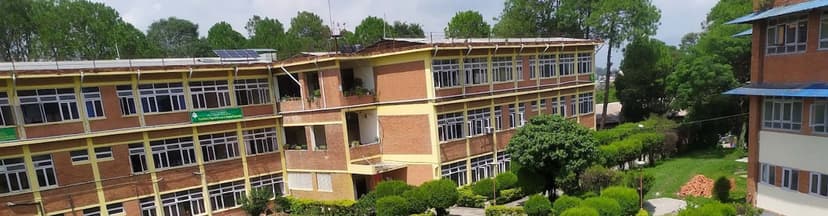
Master fo Science (MSc) in Energy Efficient Building is a 2 year, four semester program by Tribhuvan University, Institute of Engineering.



Duration
Discipline
Level
Affiliation
Last Updated
Applicants must have completed a four-year Bachelor's degree in Civil Engineering or a five-year Bachelor's degree in Architecture from Tribhuvan University or any other recognized institution. Degrees must be equivalent to those offered in the specified fields.
Candidates must obtain at least the minimum qualifying score set by the Faculty Board in the entrance exam conducted by the Institute of Engineering.
1st Semester
S.N. | Course Code | Course Title |
|---|---|---|
1 | EB 821 AE | Building Physics |
2 | EB 822 AE | Climatology |
3 | EB 823 AE | Energy Efficiency in Building Structure |
4 | EB 824 AE | Heating, Ventilation and Air Conditioning (HVAC) |
S.N. | Course Code | Course Title |
|---|---|---|
1 | EB 871 AE | Research Methodology |
2 | EB 872 AE | Energy Diplomacy and Energy Economics |
3 | EB 873 AE | Elective - A1 |
4 | EB 874 AE | Elective - A2 |
S.N. | Course Code | Course Title |
|---|---|---|
1 | EB 922 AE | Elective - B1 |
2 | EB 923 AE | Elective - C1 |
3 | EB 924 AE | Group Project Work |
S.N. | Course Code | Course Title |
|---|---|---|
1 | EB 971 AE | Thesis |
S.N. | Subject Title |
|---|---|
1 | Passive Building Operation and Maintenance |
2 | Climate Change and its Impact on Energy Efficiency in Building |
3 | Energy-Efficient Design for Public Buildings |
4 | Energy Efficiency and Retrofitting |
S.N. | Subject Title |
|---|---|
1 | Solar Energy Design (Thermal and Photo Voltaic) |
2 | Solar Energy Transmission and Grid Connection |
3 | Solar Energy for Industries and Public Sectors |
4 | Solar Power System Control and Operations |
5 | Renewable Energy Design |
S.N. | Subject Title |
|---|---|
1 | Energy Efficiency Systems Modelling and Analysis |
2 | Energy Efficiency Strategy |
3 | Energy Policy and Regulations |
4 | Green Building Design Analysis Operation and Maintenance |
5 | Energy Efficiency in Urban Settlements |
6 | Sustainable Settlement Planning, Designing, Project Development, and Management |
S.N. | Subject Title |
|---|---|
1 | Energy Policies and Barriers to Energy Distribution |
2 | Energy Trade-off |
3 | Energy Efficiency and Audit |
4 | Reliability and Risk Analysis |
5 | Multi-Criteria Decision Analysis (MCDA) |
Understand principles of energy-efficient building design
Apply passive and active energy-saving techniques
Use building energy modeling and simulation tools
Analyze building materials and thermal performance
Design HVAC and lighting systems for efficiency
Integrate renewable energy into building systems
Evaluate building codes and sustainability standards
Conduct energy audits and performance assessments
Promote green building practices and certifications
Address environmental and economic impacts of buildings
Collaborate in interdisciplinary building projects
Prepare for careers in architecture, engineering, and sustainability consulting
Master fo Science (MSc) in Energy Efficient Building is a 2 year, four semester program by Tribhuvan University, Institute of Engineering.